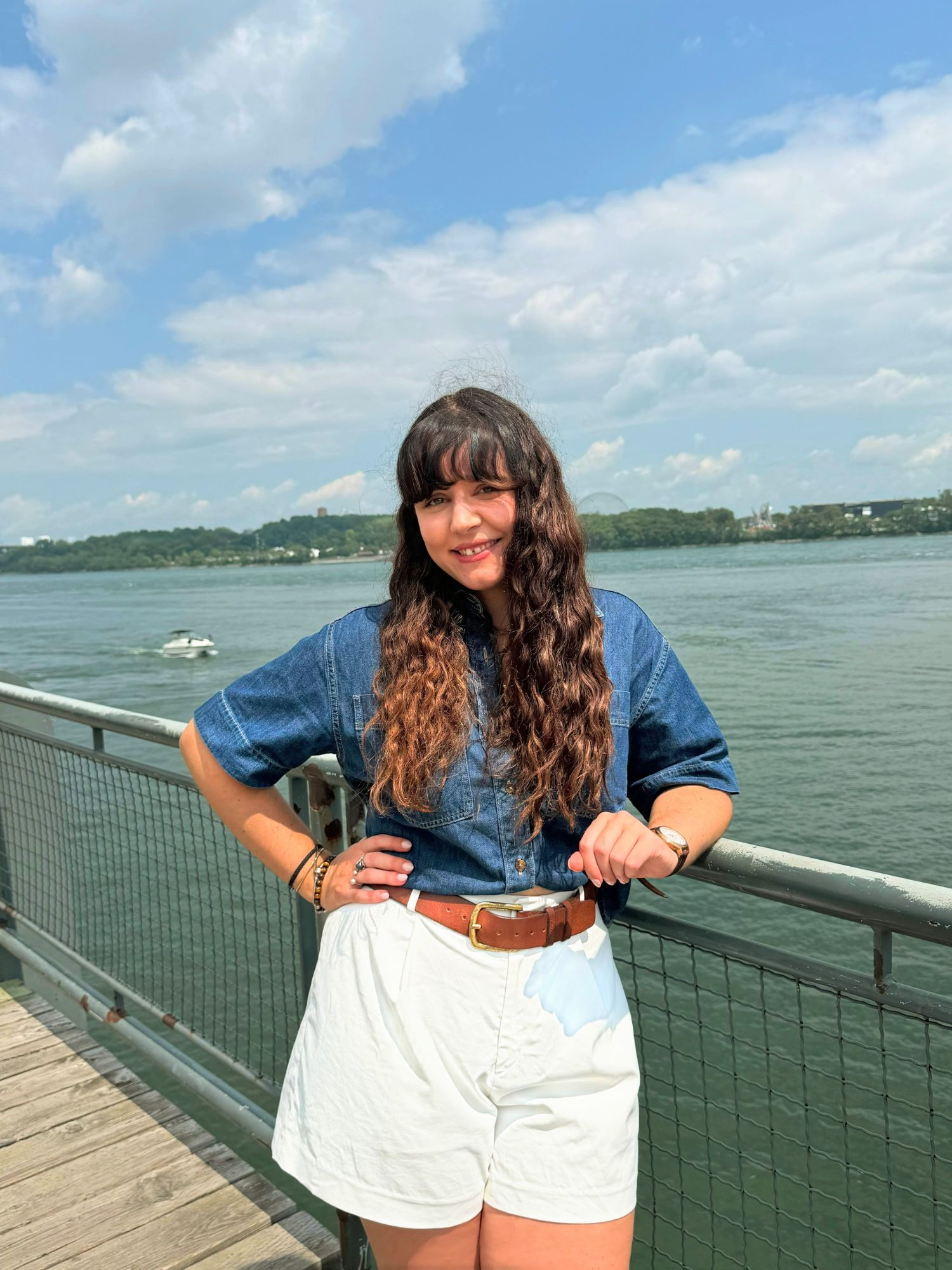
Roxane Kasprzyk is an alumna of the UNESCO Chair in Urban Landscape. After three years working at the Chair as a research and communications assistant, she has completed her research-based Master’s in the “City, Territory, Landscape” option, graduating with the distinction “excellent.”
Her research looks at moments of intimacy in public riverside spaces, using the shores of the St. Lawrence River in Montréal as her field of study. Her starting point: today’s cities tend to design public spaces around function, often at the expense of how people actually relate to one another there. Riverfronts, in particular, are being reshaped with real potential for social life, but that potential is rarely grounded in a close understanding of how people actually use these spaces.
Through an exploratory qualitative approach, Roxane examined how these small moments of intimacy take shape — through interactions between people, the layout of space, and the river’s own presence — and how they can be observed and described. Her findings show that intimacy emerges through action, at the intersection of social, spatial, and sensory factors. The river itself plays an active role, orienting bodies and gazes, shaping sensations, and mediating how people relate to one another. Thresholds, meanwhile, turn out to be dynamic in-between spaces, letting people gradually settle into small pockets of intimacy.
This relational, sensory reading of riverside public space gives urban designers and decision-makers a concrete way to identify these dynamics and design spaces that are more adaptable, inclusive, and rooted in how people actually experience them.
Beyond her research, Roxane has contributed to several projects at the Chair, including the Studio UNESCO exhibitions, interdisciplinary workshops, and the Chair’s podcast — always with an eye toward inclusion in public space and riverside life around the world.
Looking ahead, Roxane hopes to draw on both sides of her training — design and research — to keep working at their intersection, making scientific knowledge in urban planning more accessible.
Congratulations, Roxane!