UNESCO Studio
New Orleans
Fostering the quality of lives of the Mississippi River
completedThe UNESCO Studio New Orleans develops seven innovative design interventions that enhance the quality of lives along the Mississippi River and promote coexistence between human and non-human life forms. This initiative forms part of Fluvialités, a global research program on continental river governance led by Professor Shin Koseki, UNESCO Chair in Urban Landscape at the University of Montréal. Fluvialités produces practical and transferable knowledge that supports inclusive and sustainable approaches to river and land management worldwide. The Chair’s research focuses on three key pillars: biodiversity, digital innovation, and social inclusion. The team conducts activities both locally in Montréal and across international contexts.
Numbers
19 km of riverfront
The UNESCO Studio proposes design interventions for seven neighborhoods across New Orleans and Gretna, reaching beyond the city center along the Mississippi River coastline.
51 Collaborators
Over fifty individuals from academia, professional practice, international bodies, local institutions, and government contribute to the studio through lectures, field visits, and collaborative sessions.
15 Institutions
The studio builds partnerships with universities, private industry, grassroots organizations, and municipal agencies, fostering cross-disciplinary collaboration among students, scholars, and professionals.
23 Emerging professionals trained
Between May 19 and 30, the studio trains 23 graduate students in architecture, urban planning, industrial design, and landscape architecture. Representing five universities across two countries, participants engage in an intensive, interdisciplinary learning experience.
2 Exhibitions
The program concludes with the public exhibition New Orleans Beyond, held from May 30 to June 14 in New Orleans, featuring the seven design interventions. A second exhibition was held in Montréal in January 2026.
Impacts
Innovative design
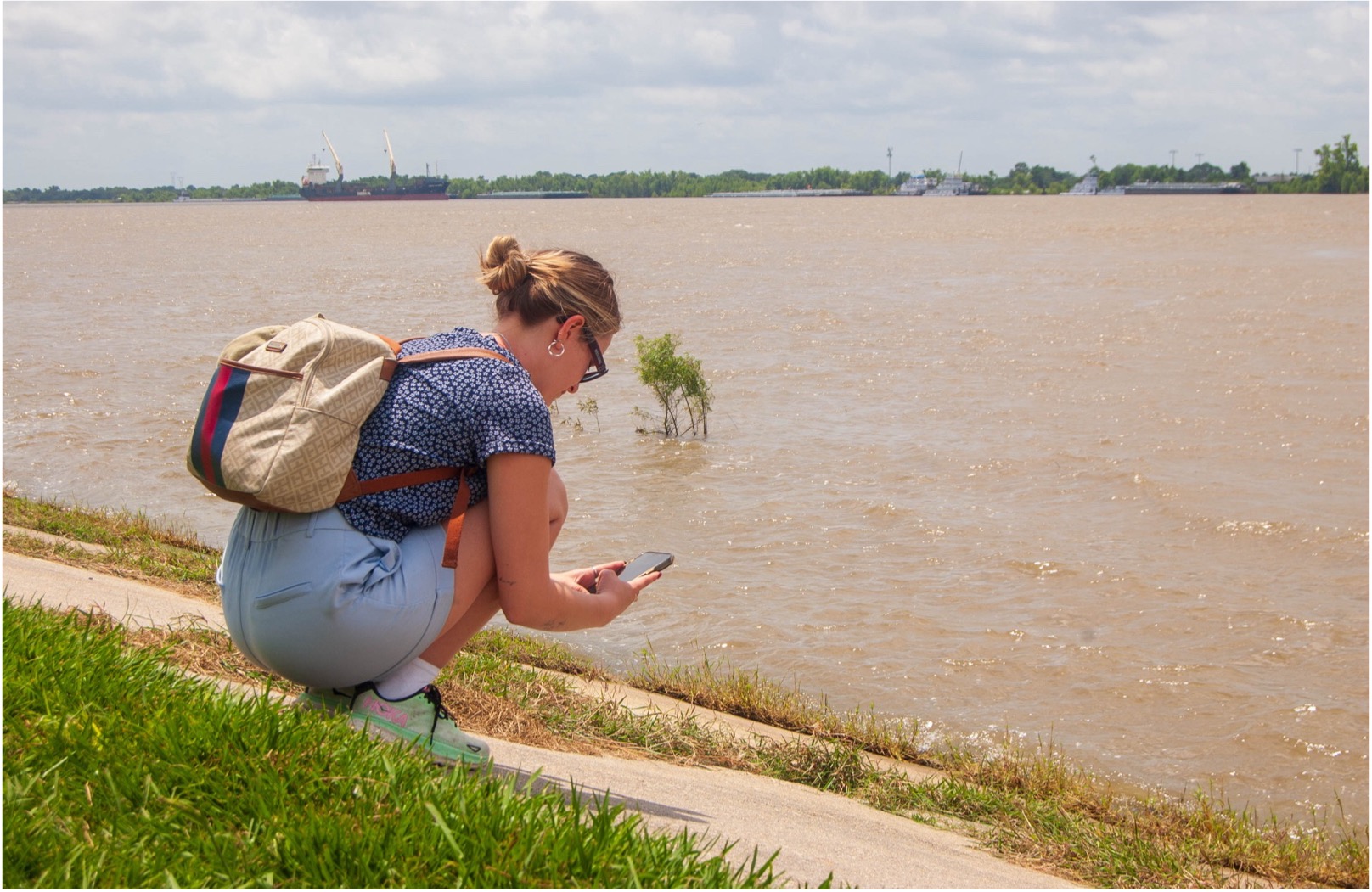
The studio presents seven design concepts that respond to the lived realities of communities in New Orleans and Gretna along the Mississippi River. Through hands-on research and direct local engagement, the proposals introduce low-tech, small-scale interventions that reconnect human and non-human beings with the river and enhance daily life along its banks.
Intersectoral Collaboration
The studio brings together people from the disciplines of architecture, landscape architecture, design, urban planning, law, economics, anthropology and environmental protection. This collaboration builds a deeper understanding of urban challenges and strengthens interdisciplinary planning processes.
International partnership
The studio fosters long-term international partnerships by addressing shared urban challenges. It connects countries and institutions during the workshop, but through ongoing relationships that continue to grow beyond the project.
Training
The studio trains 23 graduate students from five universities in the United States and Canada: Tulane University, Louisiana State University, McGill University, Laval University, and the University of Montréal. Students participate in six lectures, five guided tours, a week of fieldwork, and a week-long studio to develop innovative design proposals.
Outreach
The New Orleans Beyond exhibition runs from May 30 to June 14, 2025, at the Albert and Tina Small Center for Collaborative Design in New Orleans. Each display highlights a neighbourhood and shows how small-scale, low-tech interventions can improve life along the Mississippi. The exhibition invites visitors to experiment with representation techniques used during the studio, such as watercolour and clay modelling, and to create their representations of their neighbourhood. The UNESCO Chair in Urban Landscape expands public engagement and visibility of the event across social media platforms, including Instagram, Facebook, LinkedIn, and Bluesky.
People
Rudy Bazenet & Scott Tilton
Co-founders of the NOUS Foundation, Bazenet and Tilton dedicate themselves to reviving French and Creole languages in Louisiana. Their space serves a label studio, a publishing house and an exhibition centre. Their most recent publication, Musique(s) is a modern collection of Louisiana music performed in French and Creole. During the UNESCO Studio, Bazenet and Tilton open their doors to the participants and coordinate visits to the Historic New Orleans Collection and the New Orleans Museum of Art, thanks to their strong network in New Orleans.
Bazenet, R., & Tilton, S. (2025, May 21). New Orleans Foundation for Francophone Cultures. UNESCO Studio New Orleans, New Orleans.
Terri Dreyer
Dreyer is a distinguished architect and co-founder of NANO, a local architecture firm with international recognition, including their “Submerged Experience,” an award-winning exhibition at the 2021 Venice Biennale. Dreyer shares insights from her professional experience designing in New Orleans, helping students understand the practical realities of architectural practice in vulnerable coastal environments.
Dreyer, T. (2025, May 26). NANO. UNESCO Studio New Orleans, New Orleans.
Joseph Dunn
Joseph Dunn is recognized for his leadership in advancing the visibility and value of French and Creole cultures through government roles, international collaborations, and his current work at Laura: Louisiana’s Creole Heritage Site. Laura plantation offers visits to the site, centring the lived realities of enslaved people and highlighting the ongoing importance of honest storytelling in historic interpretation.
Dunn, J. (2025, May 24). Laura Plantation: Louisiana’s Creole Heritage Site. UNESCO Studio New Orleans, Vacherie.
Emily Federer
Director of Sustainable Development at the Port of New Orleans, Federer’s keynote emphasizes how sustainability and economic growth can align through smart port development and community-centred environmental stewardship.
Federer, E. (2025, May 27). Port of New Orleans. UNESCO Studio New Orleans, New Orleans.
Peggy Feehan
Executive Director of the Agence des Affaires Francophones, Feehan promotes Louisiana’s ties to the Francophone world. She aligns her agency’s mission with the studio’s exploration of cultural and linguistic heritage during her visit.
Feehan, P. (2025, May 27). Agence des Affaires Francophones de Louisiane. UNESCO Studio New Orleans, New Orleans.
Austin Feldbaumm
Serving as Hazard Mitigation Administrator for New Orleans, Feldbaumm presents the city’s strategies for resilience against natural and human-made threats. He underscores the importance of forward-thinking disaster planning.
Feldbaumm, A. (2025, May 27). Hazard Mitigation in New Orleans. UNESCO Studio New Orleans, New Orleans.
Kelvin E.Y. Low
Kelvin E.Y. Low is a professor and the head of the Department of Sociology and Anthropology at the National University of Singapore. His research interests include sensory studies, social memory, heritage and historiography, migration and transnationalism, and food and foodways. In his lecture, he gives in-depth information on sensory approaches in urban studies, providing an introduction to the methodologies used in the first phase of the UNESCO Studio.
Low, K. E. Y. (2025, May 13). Intersecting urban histories, heritage-making and sensory approaches. UNESCO Studio New Orleans, online.
Collin Makamson & Susie Trenka
Makamson is curator of Education, and Trenka works as a museum interpreter at the Historic New Orleans Collection. During the UNESCO Studio, Trenka leads the participants through the exhibitions Making It Home: From Vietnam to New Orleans and Edge of Tomorrow: Aerial Views of Louisiana’s Changing Coastline by Ben Depp, offering valuable context and interpretation. Makamson introduces the participants to the archives, highlighting their crucial role in preserving the history and identity of New Orleans through original documents, photographs, and other materials.
Makamson, C., & Trenka, S. (2025, May 21). New Orleans Historic Collection. UNESCO Studio New Orleans, New Orleans.
Diva Muanza
A graduate of Université de Montréal’s art history and media program, Muanza shares her research-creation project focused on the Mardi Gras Indians. Her video installation, showcased at UdeM’s inaugural triennial, offers an immersive look into this vibrant and often underrepresented cultural practice.
Muanza, D. (2025, March 21). Memoria 2020: lorsque les souvenirs ne suffisent plus. Triennale de l’Université de Montréal, Montréal.
Courtney Taylor
A curator and doctoral candidate at LSU, Taylor shares her expertise in exhibition design, guiding participants through the curatorial process and helping them shape their final displays in New Orleans Beyond.
Taylor, C. (2025, May 23). Exhibition curation. UNESCO Studio New Orleans, New Orleans.
Isabelle Thomas
Isabelle Thomas is a professor at the School of Urban Planning and Landscape Architecture at Université de Montréal and a former faculty member at the University of New Orleans. Thomas delivers a lecture on post-disaster recovery and resilient urbanism, contributing to the studio’s emphasis on climate adaptation.
Thomas, I. (2025, December 3). La Nouvelle-Orléans: Retour d’expériences. UNESCO Studio New Orleans, Montréal.
Kristi Trail & Kate Tannian
Trail, Executive Director of the Pontchartrain Conservancy, and Tannian, Museum Programming Manager, welcome participants at the Lighthouse, offering a hands-on simulation focused on water management, flood risk, and climate resilience.
Trail, K., & Tannian, K. (2025, May 21). Pontchartrain Conservancy Lighthouse. UNESCO Studio New Orleans, New Orleans.
Monique Verdin
A multidisciplinary artist of Houma descent, Verdin shares her relationship with the Mississippi River. Her storytelling wove together environmental advocacy, heritage, and artistic practice, urging respect for the river as a living entity.
Verdin, M. (2025, May 20). Artistic Approach Connecting Territory, Environment, and Culture. UNESCO Studio New Orleans, New Orleans.
Bonnie-Kate Walker
Landscape architect and associate researcher at ETH Zürich, Walker introduces visual techniques that represent ecological systems. Her lecture highlights the intersection of design and science in communicating the complexities of nature.
Walker, B.-K. (2025, May 22). Representing living systems. UNESCO Studio New Orleans, New Orleans.
Organization
- Shin Koseki (University of Montréal)
- Delphine Duplain (University of Montréal)
- Liz Camuti (Tulane University)
- Traci Birch (Louisiana State University)
- Ann Yoachim (Small Center for Collaborative Design)
Teaching
- Shin Koseki (University of Montréal)
- Liz Camuti (Tulane University)
- Traci Birch (Louisiana State University)
- Sean Fowler (Tulane University)
Logistics
- Brandon Surtain (Small Center for Collaborative Design)
- Ben Derlan (Small Center for Collaborative Design)
- Roxane Kasprzyk (University of Montréal)
List of participants
- Bell, Bronwyn (McGill University)
- Boissonneau-Perriguey, Rose (Laval University)
- Bui, Kelly (University of Montréal)
- Carvalho, Laura (University of Montréal)
- Chrun-Tremblay Bell, Shadé (McGill University)
- Bonito Dato, Koffi (University of Montréal)
- Delva, Markhly (University of Montréal)
- Gomes, Rafaela (University of Montréal)
- Joly-Simard Bell, Rosalie (McGill University)
- Kasprzyk, Roxane (University of Montréal)
- Lamonde, Marie-Soleil (University of Montréal)
- Mendoza, Andrew (University of Montréal)
- Ouimet-Gauthier, Anne-Sarah (University of Montréal)
- Pigeon, Steffie (University of Montréal)
- Potteck, Joël (University of Montréal)
- Poulin-Dubé, Liliane (University of Montréal)
- Rabellino, Hugues (University of Montréal)
- Restrepo, Catherine (Tulane University)
- Sélim, Justine (University of Montréal)
- St-Jean, Xavier (University of Montréal)
- Tremblay, Thomas (University of Montréal)
- Uctu, Ümmühan Nur (University of Montréal)
- Weinstein, Daniel (Louisiana State University)